Adaptive Systems
Research Program — Adaptive Interfaces for Human Flourishing

Focus Habitat

Designing homes for fluctuating executive capacity.

How might living environments reduce the executive burden required to begin, transition between, and complete everyday activities?

A speculative adaptive home that treats the environment as cognitive infrastructure — reducing the hidden executive load between intention and action.

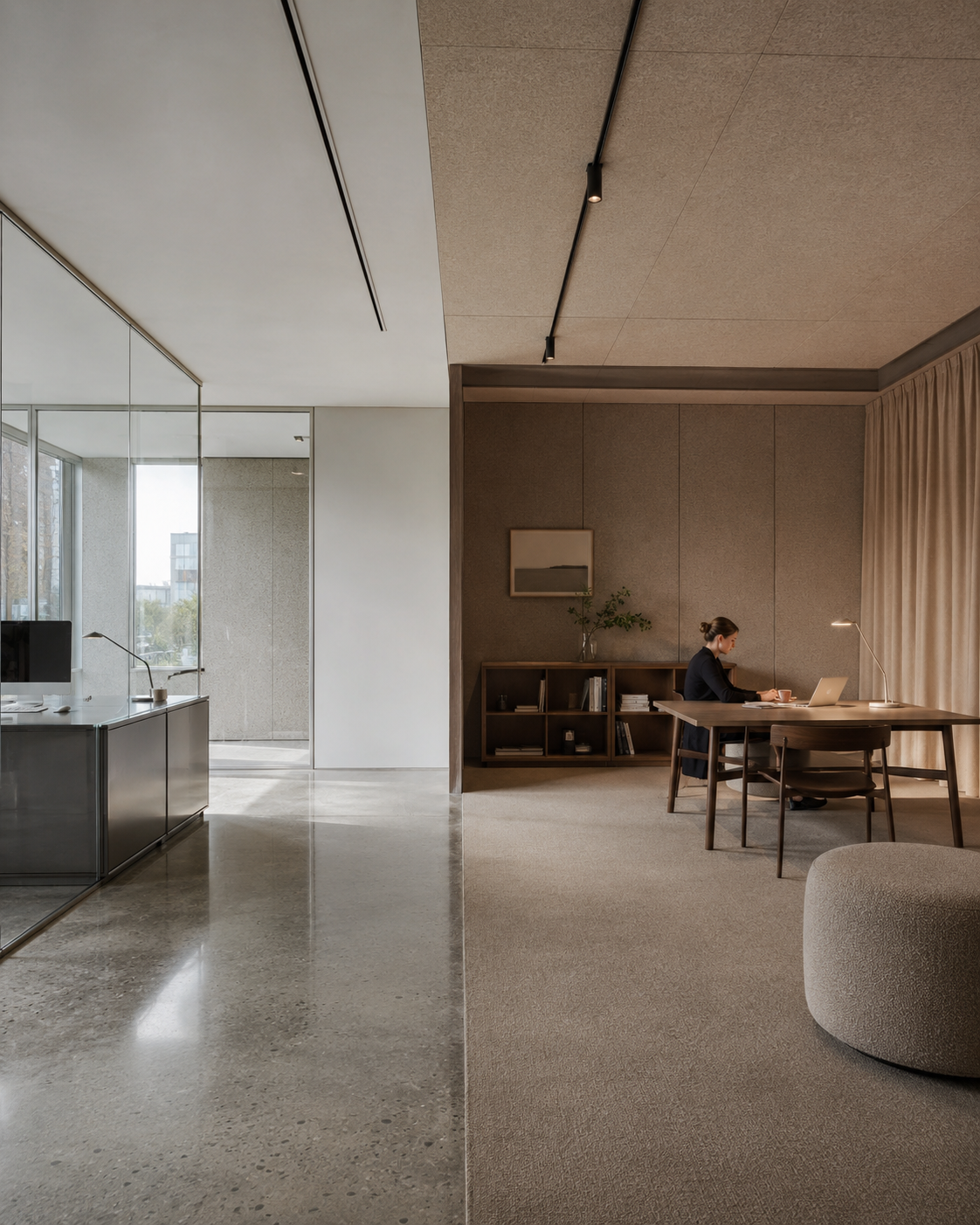
A calm, minimal interior — a person working quietly at a desk in a softly lit, materially restrained room
Fig. 01 — The home as cognitive infrastructure

Environmental study — a place that makes the next action easier to perceive.

A behavioral truth

Executive capacity fluctuates. Most homes assume it does not.

Traditional living environments quietly depend on consistent attention, working memory, planning, sequencing, task initiation, and emotional bandwidth. Daily life is less stable.

The challenge may not be discipline. It may be environment mismatch.

When capacity drops
Interruptions accumulate.
Energy changes.
Objects move.
Tasks compete.
Transitions arrive before the previous activity feels complete.

When capacity drops, the home often becomes another system the person must manage.

Narrative
Anna 32
AuDHD product designer

“I can manage a multimillion-dollar project. I can’t find my keys.”

The contradiction is only apparent. At work, roles are defined, deadlines are visible, information is externalized, and other people create structure.

At home, accumulated cognitive load finally becomes visible. Clutter grows. Transitions stall. Important items disappear from awareness. Simple activities become difficult to initiate because each one contains a chain of hidden decisions.

What looks like disorganization may reflect a mismatch between environmental demands and the executive resources currently available.

Friction

The environment asks people to continuously compensate for its design.

Most homes quietly depend on
working memory planning sequencing task initiation prospective memory object visibility self-monitoring repeated decision-making
Common failure points
Forgotten essentials
Missed transitions
Clutter paralysis
Competing visual signals
Task avoidance
Abandoned routines
Shame after systems fail
Desired state

Functional

Help me move through ordinary activities with fewer hidden steps and decisions.

Emotional

Help me feel capable and supported rather than corrected.

Social

Help my home reflect the life I am trying to live — not the capacity I am expected to maintain every day.

Research insight

Across executive-function support, cognitive accessibility, occupational therapy, and environmental design, a consistent principle appears.

Function can improve when demands are moved out of memory and into the environment.

Designated locations, visible cues, reduced complexity, contextual prompts, and externalized task structure can reduce the executive control required to act.

This led to a reframing

The problem is not productivity. The problem is friction between intention and action.

The concept

A home that helps you start.

A speculative adaptive home designed to reduce activation energy and support momentum during everyday activities.

Potential contextual inputs
time of day user-defined routines calendar transitions room-level activity shared device states manual support modes
Potential environmental responses
01

Contextual Lighting

Lighting identifies the active zone or supports a transition between activities.

02

One-Step Prompts

A display surfaces one relevant action rather than an entire task list.

03

Visible Time

Timers and temporal cues make duration and transitions easier to perceive.

04

Object Anchors

Designated surfaces and optional location support reduce the burden of remembering where essentials were placed.

05

Transition Modes

The environment shifts between departure, focus, meal, recovery, and evening states.

06

Sensory Simplification

Selected distractions are reduced when the user activates a lower-stimulation mode.

No productivity theater. No moral judgment.

The environment makes action easier to enter.

Experience scenario
8:07 AM Anna needs to leave for an important meeting.
Typical experience
Keys are missing. The charger is in another room. Her phone becomes a distraction. Incomplete tasks compete for attention. Stress rises while departure stalls.
Focus Habitat response

The entry zone becomes visually distinct. Nonessential household cues recede from view. A visible departure timer makes the remaining transition time concrete.

Before you leave
Keys Laptop Water
Key surface — presentleave in 12 min
3:12 PM Task initiation stalls. The first action remains undefined.
Anna activates Focus Mode

The desk area becomes the only emphasized zone. A single starting action appears. A visible timer begins with a short work interval.

Start here

Open the proposal and write three headings.

25:00 work interval

The intervention does not demand sustained motivation.

It lowers the threshold for beginning. The environment does not complete the morning, or the proposal, for Anna — it reduces the number of things she must hold in mind at once.

Design principles

Move structure out of memory and into the home.

01

Reduce Activation Energy

Make the first useful action easier to identify and perform.

02

Externalize What Must Be Remembered

Do not require working memory when the environment can hold the information.

03

One Signal at a Time

Reduce competing cues and surface only what is relevant now.

04

Shame-Free Interaction

Support without correction, scoring, or moral judgment.

05

User-Controlled Adaptation

The person determines which routines, signals, and data the home may use.

06

Graceful Failure

The environment should remain usable when automation fails or the person chooses not to follow the suggested path.

Evidence & validation
Evidence level Research-informed speculative environment

The concept is informed by existing approaches to environmental modification, cognitive accessibility, external cueing, designated object locations, task simplification, and smart-home automation.

The integrated Focus Habitat system has not been tested as a complete environment. Claims regarding improved task completion, reduced stress, or executive-function performance remain hypotheses until evaluated with users in real homes.

A future prototype should investigate
Whether environmental cues reduce time to task initiation
Whether one-step prompts reduce perceived overwhelm
Whether object anchors reduce search behavior
Whether adaptive zones help or distract
Which automations feel supportive versus intrusive
How needs differ across users and contexts
Whether the system creates dependence or loss of agency
What data users are willing to share
Whether benefits persist after novelty declines
Speculative modeling

Cognitive accessibility through environment.

Homes designed around fluctuating human capacity rather than idealized consistency. The opportunity may not be another productivity application — it may be environments that require less compensation from the people inhabiting them.

Potential applications
neuroinclusive housing aging-in-place caregiver households student housing remote-work settings behavioral-health environments post-acute recovery supportive independent living
Why now — 01

Smart-Home Infrastructure Exists

Lighting, presence sensors, connected surfaces, and environmental controls are increasingly available.

Why now — 02

Neurodiversity Is Reshaping Design

More people are naming the ways conventional environments create avoidable cognitive burden.

Why now — 03

Productivity Software Is Saturated

People have more reminders and dashboards than ever, while initiation and follow-through remain difficult. The next frontier may be contextual support rather than additional information.

Future hypothesis

Contextual environmental supports may reduce the executive effort required to initiate and transition between everyday activities.

The central research question is not whether automation can perform more household tasks.

It is whether the home can present the right amount of structure without reducing autonomy.

What I learned

Many people do not need more motivation.

They need fewer hidden requirements between intention and action. When homes assume perfect memory, consistent attention, reliable planning, and unlimited emotional bandwidth, ordinary activities become harder than they need to be.

The future of accessibility may include environments that quietly hold context, simplify the next step, and ask less of the people living within them.

Connection to a larger body of work
Project Primary contribution
Focus HabitatYou are hereCognitive infrastructure across the home
Laundry LoopReduced decision burden within one task
Field SleeveMaterial reduction of environmental load
Resonance MethodSensory signaling language
SomatagDetection and timing of support AttuneCareRecovery-supportive healthcare environments
Wild WindowRestorative environmental access

Each investigates a shared question: what happens when the surrounding interface carries more of the burden of adaptation?

Explore Adaptive Systems Explore Laundry Loop Work With Christine →