Adaptive Systems
Research Program — Adaptive Interfaces for Human Flourishing

AttuneCare

Designing healthcare environments that participate in recovery.

Hospitals heal bodies. They often dysregulate minds.

AttuneCare is a research-informed concept for an adaptive patient environment that responds to changing human capacity — not only the clinical chart.

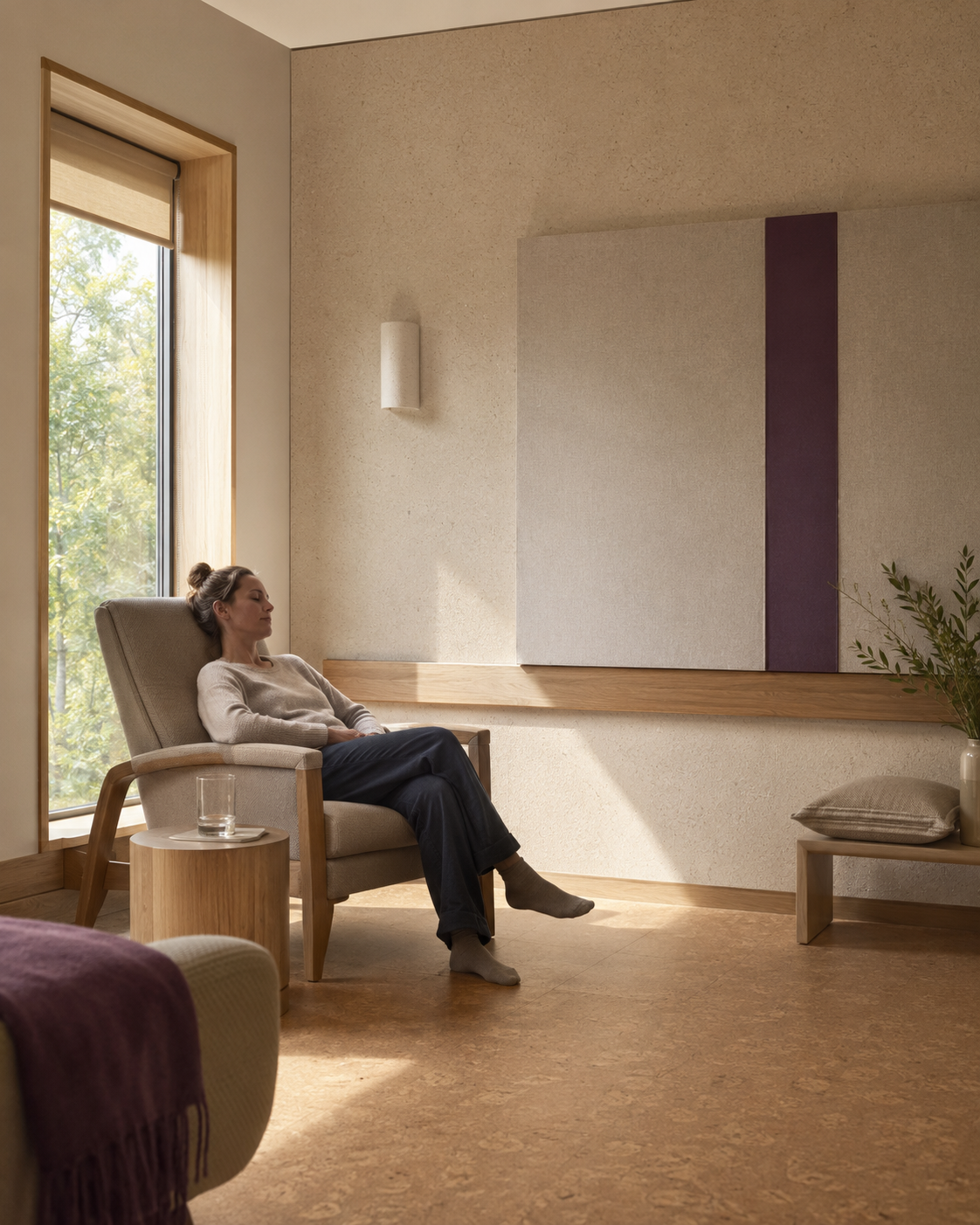
A patient resting in a chair by a window in a calm, warm recovery room — soft daylight, natural materials, a glass of water within reach
Fig. 01 — The room as a condition of recovery

Environmental study — recovery does not occur outside the room.

01 — The Question

How might healthcare environments reduce the sensory, cognitive, and emotional burden of recovery?

Healthcare environments are designed primarily for clinical delivery. Patients experience them through the body.

Before someone can fully process a diagnosis, treatment plan, or discharge instruction, they are already responding to the room around them.

Already responding to
Light.
Sound.
Temperature.
Pain.
Interruption.
Uncertainty.
Unfamiliarity.
Loss of control.

The environment is not neutral. It participates in care.

02 — The Human Experience
Henrik 74

Hospitalized following a cardiac event. Machines beep. Staff rotate. Sleep is interrupted. Information arrives in fragments. Family members leave for the night.

The room becomes the primary environment through which recovery occurs.

“I know people are trying to help me, but I can’t relax.”

Henrik is expected to rest, understand new information, participate in decisions, and regain function — while experiencing pain, medication effects, fatigue, uncertainty, and sensory disruption.

The challenge is not simply delivering excellent medical treatment.

It is creating the conditions in which a patient can rest, orient, understand, and recover.

03 — The Friction

Traditional inpatient environments create competing demands.

Frequent and unpredictable interruption
Poorly timed or overly intense lighting
Unfamiliar sensory conditions
Fragmented communication
Disrupted sleep
Limited personal control
Anxiety about what is happening next
Loss of familiar routines

Clinical treatment and environmental experience are often designed as separate systems. Patients experience them simultaneously.

Desired state

Functional

Support rest, orientation, comprehension, and recovery.

Emotional

Help the patient feel safer and less overwhelmed.

Social

Preserve dignity, autonomy, and connection during vulnerable moments.

04 — The Research Insight

Recovery does not occur outside the environment. A patient’s nervous system continues to interpret environmental conditions even when their cognitive capacity is reduced by illness, pain, medication, fear, or sleep disruption.

Light, sound, temperature, rhythm, familiarity, and perceived control can influence how the care experience is tolerated and understood.

This led to a reframing

The room is not simply where care happens. The room is one of the conditions shaping whether recovery is possible.

Rather than asking patients to continually manage stressful surroundings while recovering, AttuneCare explores how the environment might carry more of that burden.

05 — The Concept

The AttuneCare Room

A speculative adaptive-care environment designed for periods when patient capacity is reduced.

Six coordinated environmental layers support orientation, rest, safety, and human connection.

01

Circadian Lighting

Gradual changes in intensity and warmth help distinguish day, evening, and night without relying on harsh overhead lighting.

02

Pathway Guidance

Low-level amber lighting supports safe nighttime movement without fully activating the room.

03

Orientation Support

A calm, legible interface communicates time, place, care-team information, and the next expected care activity.

04

Acoustic Modulation

The room reduces avoidable noise and maintains quieter conditions during sleep and recovery periods.

05

Passive Environmental Sensing

Non-contact sensing detects broad changes in movement or room activity without requiring the patient to manage another wearable or interface.

06

Care-Team Cueing

Subtle notifications help staff recognize possible distress or escalating need while avoiding unnecessary alarms.

The goal is not to fill the room with more technology.

The goal is to coordinate existing environmental systems around the changing capacity of the patient.

06 — Experience Scenario
2:14 AM Henrik wakes unexpectedly.
Typical experience
Bright overhead lighting. Unfamiliar sounds. Disorientation. Rising anxiety. Difficulty returning to sleep.
AttuneCare response

Movement is detected near the bed.

Low-level pathway lighting activates, supporting safe movement without illuminating the entire room.

Nonessential sound is reduced.

No immediate alarm is generated. The system briefly observes whether Henrik appears to settle or requires assistance, according to clinically approved escalation rules.

2:14 AM · Cardiac Recovery Unit

You are safe. You are recovering in the hospital.

Your next scheduled check is at 3:00 AM. Press the call button whenever you need help.

Henrik returns to bed. The orientation display dims. Pathway lighting fades gradually. The room returns to its recovery state.

The intervention is quiet, understandable, and reversible.

It does not demand that Henrik operate a new device while disoriented.

07 — Design Principles

Recovery before efficiency.

01

Recovery Before Efficiency

Operational needs should not unnecessarily undermine patient recovery.

02

Orientation Is a Care Function

Knowing where one is, who is present, and what will happen next can reduce avoidable uncertainty.

03

Preserve Patient Agency

Environmental adaptation should remain visible, understandable, adjustable, and reversible.

04

Reduce Competing Signals

The room should not demand attention from every direction.

05

Design for Reduced Capacity

Interfaces must remain usable during pain, fatigue, fear, medication effects, and cognitive disruption.

06

Escalate Carefully

The system should support — not replace — clinical judgment. Environmental adaptation must not delay care or conceal meaningful changes in patient condition.

08 — Evidence and Evaluation
Evidence level Research-informed speculative environment

The complete adaptive-room system has not yet been clinically tested. AttuneCare therefore does not claim to reduce delirium, falls, sedative use, length of stay, or other clinical outcomes. Those remain testable hypotheses.

AttuneCare draws from
Environmental psychology Sleep & circadian research Patient-experience design Healthcare human factors Dementia-friendly design Sensory design Smart-building infrastructure
A research table — a ring-bound sketchbook of environmental studies, an HRV plot, calipers, material chips, and prototype parts in warm light
Fig. 02 — The evidence is studied before it is claimed
Initial evaluation priorities — a phased pilot could examine

Experience

Perceived safetyPerceived controlOrientationSleep disruptionPatient & family satisfaction

Behavioral

Nighttime call-button useAttempts to leave the bedTime to settle after wakingFrequency of environmental overrides

Operational

Alarm burdenStaff interruptionWorkflow compatibilityIntervention reliability

Clinical exploratory

Delirium screening resultsSedative exposureFalls & near-fallsLength of stay

The first question is not whether AttuneCare transforms every clinical outcome.

It is whether a coordinated environment can reduce avoidable burden without creating additional work or risk.

09 — Why Now

The missing layer is orchestration.

Smart-building systems, passive sensing, programmable lighting, acoustic controls, and room-based interfaces already exist. Most hospital technologies operate as separate products optimized for separate functions.

AttuneCare asks what becomes possible when those systems are coordinated around the patient’s changing capacity.

The opportunity is not simply to make hospitals smarter.

It is to make care environments more supportive of the human conditions under which healing occurs.

10 — Future Hypothesis

Coordinated environmental adaptation may improve orientation, perceived control, rest, and the overall recovery experience while reducing unnecessary sensory and cognitive burden.

The primary research question is not whether one lighting or sound intervention works in isolation.

It is whether the room can behave as a coherent, patient-centered recovery system.

11 — What I Learned

Patients do not experience healthcare as a collection of clinical services.

They experience it as a sequence of rooms, interruptions, sensory conditions, relationships, and moments of uncertainty.

Clinical intelligence helps determine what treatment is needed.

Environmental intelligence may help determine whether the patient can rest, orient, participate, and recover within it.

12 — Connection to the Research Atlas

AttuneCare investigates recovery under reduced capacity.

It sits within a larger atlas of projects, each studying a different human constraint.

Project Primary human constraint
Focus HabitatExecutive function Laundry LoopTask completion
Field SleevePhysiological load
Resonance MethodRegulatory signaling
SomatagTimely detection and support
AttuneCareYou are hereRecovery
Caregiver SystemsCapacity
Wild WindowRestoration

Together, these projects examine one shared question:

What happens when the surrounding system carries more of the burden of human adaptation?

Explore Adaptive Systems Explore Focus Habitat Work With Christine →